
Reading without Reason
a homily

Every few months I preach at my church. It’s a privilege, and a nice opportunity to write and think in a register that I usually don’t, as an academic. I have taken to adding my manuscripts here for any curious friends and family.
You can listen to me speak the sermon here.
Our Scripture this week was Matthew 14:22-33.
Whenever I happen to be around young people, I’m always trying to figure out what they know. I’m curious to hear what their life is like, what they notice about the world, what their perspective is on the state of things, all of which is so much different than mine. I had a great opportunity to do this on Wednesday when I was with the church youth group at Kings Island. All day I overheard stories about kids from school, debates about TV shows and movies and memes, discussions on favorite foods and candy, observations on the quality of the last rollercoaster, and opinions on anything and everything under the sun.
One particularly talkative and inquisitive youth became fixated on the question, “So, who’s at fault if one of us gets seriously injured on a rollercoaster? Did we sign our life away on some kind of waiver?” This idea of waivers and contracts was fascinating to him. It’s a good question, to be fair, but maybe not the best lunch table talk for those who are already nervous. He was prying for some real solid answers from the adults; he was persistent and would not rest until he got a firm response. Trying to lead him off the trail—and I couldn’t help myself—I said, “Hey, I got a question for you. Do you know what a ‘legal gray area’ means?” In his frank manner, he responded, “No, I don’t care what a gray area is. All I want is for you to give me a yes or no answer to my question.”
Not only did he completely miss the point of my question, which had my solution for him baked into it, but the idea I was about to offer didn’t even fit into his view for how the world could work. He believed that there was one singular answer—one person would have to be held responsible in case of emergency. Either Tyler [our youth pastor] is going to jail if I break a leg, or the CEO of King’s Island is going to jail. Because of this conviction any answer that complicated his worldview simply would not compute.
We sometimes imagine that this type of thinking—fixated on the either/or, the binary, the yes or no, the true or false—is exclusive to the domain of young people, but it’s the way we think, too, you and I as mature adults, every single day. It’s the false dichotomy, and it’s comfortable, it’s neat, and most deceptively, it seems logical. We think that because we’re using our brains to deduce an answer, what we conclude cannot be wrong.
This is what we often call reason, and in its most nefarious forms, it can lead us toward a life and convictions that seem logical and sensible, but inside are a mess with contradictions. Most things are more complicated than that, existing in the gray area.
We put a high price on reason in our world, and as we heard in our sermon last week, to the point of being proud that we can extract a single idea or meaning from our Scripture. This often looks like over-spiritualizing the Word, incessantly asking the text, “What does it mean? What does it want? What does it really say?” As if there is just one truth it could hold. Over-spiritualizing and over-reasoning can position us as a sort of Sherlock Holmes figure, holding a big magnifying glass over the book and picking out the secrets that only we can uncover. While this type of study can be enlightening for a moment, it can also lead us back to the faulty either/or, the true/false thinking. It also makes Scripture into a kind of textbook which we just need to study “rightly” in order to extract all the correct answers.
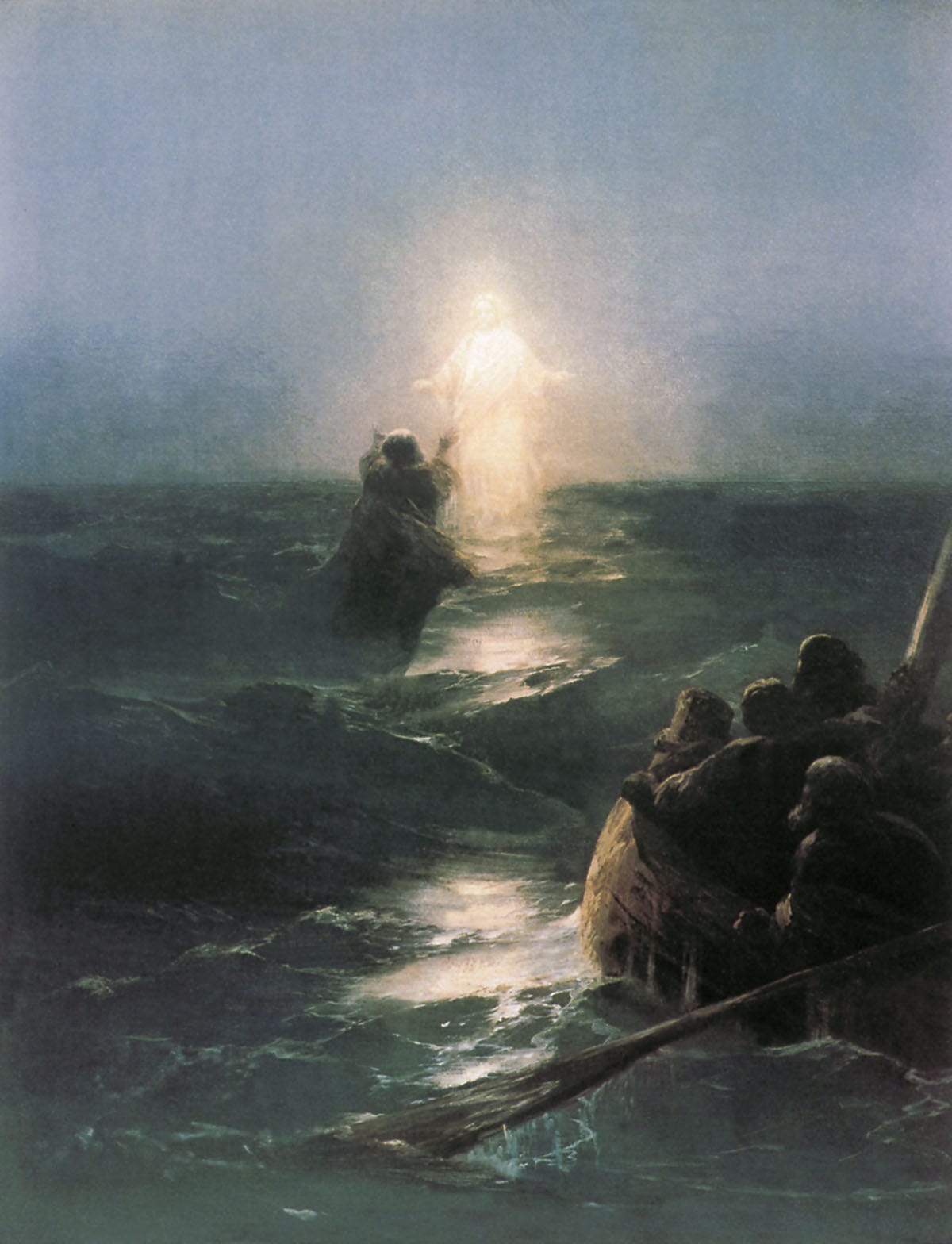
Our Matthew passage this morning, the miracle of Jesus walking on the water and calming the storm, is ripe for a good overthinking, precisely because it seems so fantastical and grand, like it’s begging for us to “make sense” of it. So instead, today I want to try focusing on some of the more subtle contours of the story. The parts that don’t jump out and give us quick answers, an easy yes or no. Let’s sit with the story for moment and ask it to speak to us afresh, not like a textbook, but like a story from a friend.
To that end we should start with hearing the Word again. It’s short and worth repeating. And if you didn’t catch it earlier, really listen in this time. Try to dwell for a moment in the picture that our author is painting for us:
Immediately he made the disciples get into a boat and go on ahead to the other side, while he dismissed the crowds. And after he had dismissed the crowds, he went up the mountain by himself to pray. When evening came, he was there alone, but by this time the boat, battered by the waves, was far from the land, for the wind was against them. And early in the morning he came walking toward them on the sea. But when the disciples saw him walking on the sea, they were terrified, saying, “It is a ghost!” And they cried out in fear. But immediately Jesus spoke to them and said, “Take heart, it is I; do not be afraid.” Peter answered him, “Lord, if it is you, command me to come to you on the water.” He said, “Come.” So Peter got out of the boat, started walking on the water, and came toward Jesus. But when he noticed the strong wind, he became frightened, and, beginning to sink, he cried out, “Lord, save me!” Jesus immediately reached out his hand and caught him, saying to him, “You of little faith, why did you doubt?” When they got into the boat, the wind ceased. And those in the boat worshiped him, saying, “Truly you are the Son of God.”
The iconic stories in the Gospels are always written so much shorter than you remember, aren’t they? This passage is only twelve verses long. With that in mind let’s think about the context of our story. Last week, as we heard, at the beginning of chapter fourteen, John the Baptist is killed, and Jesus heads off alone into a boat on the lake to mourn; in the meantime, crowds gather at the edge of the lake waiting for him to return, and when he does, he preaches and feeds the 5,000; finally, here at the end of chapter fourteen, Jesus again leaves the crowds and his disciples, this time fleeing for the mountains. But when he comes down from the mountain, he finds the twelve caught in a storm, still out on the water, so he walks to them and calms the waves.
What a whiplash series of events! I would challenge you to find a chapter in any of the Gospels where more happens. And this is all presented chronologically, within a confined period, not as separate events days or weeks apart. The first word we start with today—“Immediately”—tells us that after feeding the 5,000, Jesus right away goes up to the mountain alone.
What should we notice here, if we are trying to look at the Word today with new eyes, without the over-reasoning? What does this story draw our attention to? For me, it’s this notion of Jesus withdrawing. The passage tells us first off that there is something obvious Jesus needs: more time alone.
Our follow up question may be, so why did he do this? I’d like to suggest one reason is because he was still grieving the loss of John, his cousin. After all, earlier that day he was interrupted by the large crowds that gathered (and half a day is hardly enough time to mourn). We might think about the loved ones we have lost, and how days, weeks, months, perhaps even years go by and we still don’t feel fully ready to face a crowd.
So now after the day’s excitement and festivities, Jesus sends away his disciples, this time learning his lesson. What’s even more remote and isolated than the middle of a lake? A place no crowds can gather and no troubles can reach? A mountaintop, of course. So there he goes, where he remains all night. A place where he can finally find respite.
What does it mean that God himself needs to be alone for a while?
I’ve been fascinated lately with questions like this concerning the day-to-day life of Christ, and so the temptation here for me is try and reason my way toward an answer. I could try and formulate some theological truism about what the self-empyting Jesus, as the Son of God, needed in order to continue performing miracles, or I could imagine he went up to the mountain as a sort of predestined act so that he might then walk on water later as a demonstration of his power. But these reasons don’t feel fully correct. They’re not what the story is asking us to notice, what the text itself nudges us to see: Jesus as a man who is fully God but also fully human.
He was tired. He was grieving. He was feeling human emotions, emotions that weren’t “covered up” by his godliness but felt at their full strength. He was consumed by the burden of kingship which the people of Israel clearly wanted from him. He needed quiet. If you asked me last week where I thought the Scripture passage for today would lead us, perhaps the last thing I would say is a message about the humanity of Christ, of the necessity of his solitude, rest. This is about walking on water, for goodness sake! But this is what we have to gain when we read and reread the Word without expectation, without the demand of reason: We are surprised by its beauty and simplicity.
Truly this is a comforting image of our incarnated Lord. Jesus on the mountaintop, resting from his day of preaching, still processing the death of his friend, enjoying the stillness of his creation; maybe he feels the cool storm air blowing in across the lake below, yet he continues to pray.
But someone is always in need of rescuing by Jesus, it seems. Returning to our passage, we read that in the early morning hours—what some versions translate as the “fourth watch,” a period between 3 and 6 am—Jesus comes down from his mountain and finds his disciples terrified, stranded in the middle of the storm. An important detail here is that he did not come to their rescue immediately. All night they suffered!
As we read,
When evening came, he was there alone, but by this time the boat, battered by the waves, was far from the land, for the wind was against them.
Matthew now points our attention to the disciples’ situation. Like Jesus they shared a sleepless night, though one marked by fear rather than grief. Commentators tell us that large storms on the Sea of Galilee are possible, with waves able to reach 10 feet in height. So all night the men rocked in their boat, miserable with the sea spray splashing their faces, waves white capping over the sides; they’re probably side-eyeing the leaks in the hull which slowly let more and more water in, their ankles and then their calves soon covered, the wind unrelenting. James probably glanced over at John at one point and said something like, Dude, where the hell is Jesus? They could have felt betrayed, and certainly they felt alone. Perhaps they even thought Jesus selfish to leave them alone like this. He’s off mourning John the Baptist, getting his special alone time, but here we are about to perish in the lake!
Add on to this the fact that, as the account from the gospel of John tells us, they were physically drained because they had spent the whole night rowing, making little progress (they weren’t just bobbing up and down in the lake for fun all night, as I sometimes picture). They had crossed only about half the distance lake in the eight or nine hours they had been rowing, thirty furlongs, or about 3.5 miles. As one commentator puts it, “By this time…they must have been in a state of exhaustion and despondency bordering on despair.”
But Jesus sees the entire storm unfold from his mountaintop perch, as Mark confirms in a crucial line from his account:
He saw that they were straining at the oars against an adverse wind.
Another comforting image from this story. All night the Son of God watches those he loves struggle and fight for their lives, but he remains calm, never too busy on anything to ignore our plight. Not until the time is right does he descend to their rescue.
And when he does appear, they mistake him for an apparition, a ghost. In reply to their fear, he responds with care.
Take heart, it is I.
I can imagine how much love he had for them in this moment after spending his own sleepless night in mourning and prayer, and now he finds his disciples in dire straits. This is the heart of God—to rescue, to feel compassion. Yes, he will spend time alone, holed up on his mountaintop, God himself feeling somewhere far away and distant, but he’ll always descend and speak his name to us. “It is I.”
Peter then makes his famous appeal: “If it is you, command me to come to you.” We might ask what convinced him to do this, what gave him the boldness to appeal God for this power. I love the way one commentator explains it: “[The] disciples were expected to imitate their masters, and Jesus is training disciples who will not simply regurgitate his oral teachings but will have the faith to demonstrate his authority in practice as well.” And though Peter does ultimately fail and begin to sink, this author adds, Peter has still acted in greater faith than doing nothing at all, for he is learning how to be like Christ even in his inadequacy. I’d also like to add, what if Peter simply missed his Lord? It’s not so strange to imagine that he needed Jesus and was willing to risk the danger of crossing to get to him.
In setting aside the demands of reason for just a moment, we have the privilege of noticing that this passage is absolutely jam packed with the simple fact of human emotion—it is an entire story dictated by reactions and affects. Jesus mourns; the disciples are caught with fear at the storm and a ghost; Peter cries out with boldness, then cowers again in anxiety at the wind and waves; and finally, the disciples fall to their knees with love and worship. It runs the gamut of human experience in twelve verses.
When I was an undergraduate, I heard a great piece of advice from one of my ministry professors. He said, when you’re alone, reading the Bible, stop trying to read it like a twenty-first-century college-educated intellectual, like a preacher, like a professor, like a business man, like a teacher, like someone who the Bible needs in order to make sense. You don’t, and this is shocking, you don’t have to journal during or after your Bible time; you don’t even have to pray after you read. The miracle of the Word is that its presence exceeds our reasoning and understanding; it can grab you, infiltrate your heart, work its way into your bones on its own, the stories permeating your mind and soul in mysterious ways.
I’m starting now to see what he meant. Rereading this passage, with its fixation on the fallibility of being human, shows us that to be like Christ does not mean being perfectly reasonable. Sometimes it means, like Jesus, embracing our human need to mourn, to feel afraid, to go to the Father alone.
This week, the world will demand that you be reasonable. It will ask you to think first, feel later, and maybe even to never feel at all. It will ask you to choose between yes and no, true or false, thinking or feeling. How should the Christian react to this complicated world?
We imitate Christ, who went off to be alone. We imitate Christ, who felt all his emotions deeply. We imitate Peter, who called out with faith despite his fear. We make small choices daily that reflect the truth of our Gospel passage, recognizing that it takes more than “reason” or “thinking the right thoughts” to be like Christ. These small acts of faith are what a Christian does because we have listened closely and trusted the stories we have been told. We learn who Jesus was and how he acted, and slowly, imperfectly, we begin to imitate him.
Ralph Waldo Emerson, although hardly a pious Christian, captures the essence of this idea, that to live rightly involves more than a series of correct behaviors, of choosing between dichotomies:
Men imagine that they communicate their virtue or vice only by overt actions, and do not see that virtue or vice emit a breath every moment.
To live by virtue, to follow Christ, is not about choosing the most correct, reasonable actions, but by living as Christ might, and recognizing our every breath and emotion can be reflected in him.
This week I pray that we might remember Christ’s simple words to Peter, “Come,” when we are in need of calm; that we might feel empowered to go off and be alone when we recall Christ’s solitude on the mountain; that we might, like Peter, ask God boldly for his favor when we are up to our neck in worry; that we remember the heart of God is to rescue; that we remember Jesus himself felt, and felt deeply.
So if we feel alone, know that Christ too felt alone. To be alone and isolated is to be one with him and his grief. And if we, like the disciples, feel abandoned, caught out in the elements during the longest night of our lives, know that the winds will cease, and the waves will recede.
Hopefully we’ll see that this is the work of the Son of God, not a ghost or dumb luck or chance. Christ alone, who all along has been watching us with love from his mountaintop, has descended and spoken peace to the waves and in our hearts. Thanks be to God. Amen.
Thank you for some new insight into those scriptures.
The painting is beautiful as well.
I appreciate you sharing❤️